
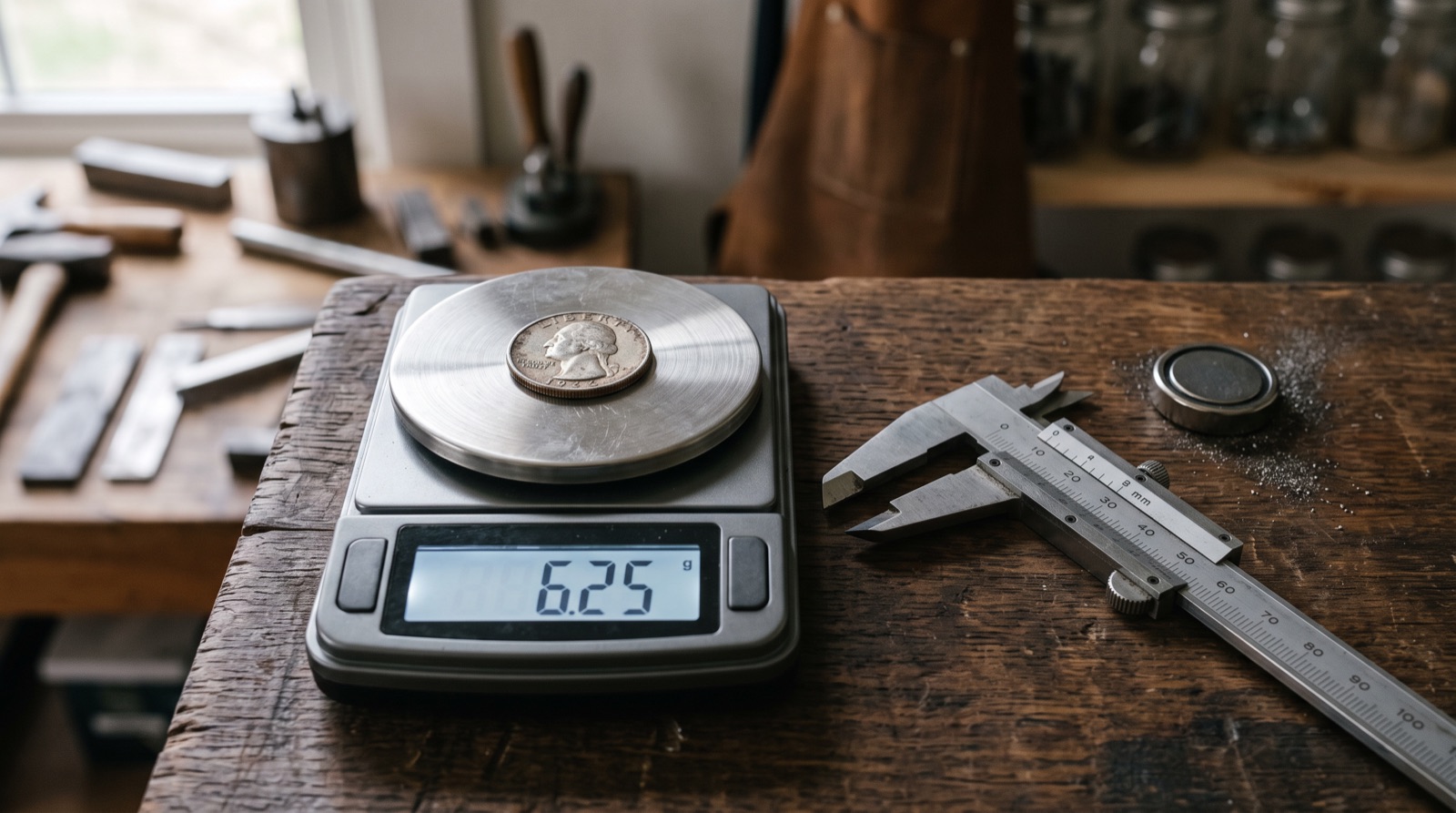
Counterfeit coins have become more convincing, and they show up everywhere from online marketplaces to flea markets. The good news is that fakes have to get a lot of things right, and they rarely manage all of them. Here are the checks that catch most of them.
Weight and dimensions
Every legitimate coin is made to a published specification for weight, diameter, and thickness. That’s the counterfeiter’s biggest problem: a fake made from cheaper metal either weighs too little at the right size or has to be the wrong size to hit the right weight.
A digital scale that reads to a hundredth of a gram and a set of calipers go a long way. For example, a one-ounce American Gold Eagle weighs about 33.93 grams and measures about 32.7 mm across, while a Morgan silver dollar should weigh about 26.73 grams at roughly 38.1 mm. Compare your readings with the mint’s specification, and treat anything noticeably off as a red flag.
Sound
Genuine silver and gold coins have a distinctive ring. Balance a coin on a fingertip and tap it lightly with another coin: real silver produces a clear, sustained, high-pitched ring, while base-metal fakes usually give a dull, short clunk. This “ping test” takes practice and works best when you compare the coin to one you know is real. Never drop or strike a valuable coin hard.
Magnetism
Gold and silver are not magnetic. A strong neodymium magnet shouldn’t grab a genuine gold or silver coin. If it sticks, the coin contains iron, nickel, or steel. Silver also reacts in a subtler way: slide a magnet across a silver bar or large coin and you’ll feel a slight drag, because silver resists magnetic fields. A magnet won’t catch every fake — some counterfeits use non-magnetic metals — but it rules out many in seconds.
The details fakers get wrong
Counterfeiters copy designs from genuine coins, and the copies show it. Look closely with a loupe at:
- Lettering and numerals: Fakes often have soft, mushy, or uneven letters, especially in the date.
- Edge reeding: The ridges on the edge should be crisp, evenly spaced, and consistent all the way around.
- Surface texture: Cast fakes can show tiny pits, bubbles, or a grainy surface where a struck coin would be smooth.
- Luster: A struck coin has a satiny glow that shifts as the light moves; many fakes look dull, greasy, or unnaturally bright.
- Impossible combinations: A date and mint mark pairing that was never struck is an instant giveaway.
When home tests aren’t enough
Some sophisticated fakes pass weight and magnet checks — tungsten, for example, is nearly as dense as gold. For valuable pieces, dealers commonly use specific gravity testing, ultrasonic thickness gauges, or X-ray fluorescence analyzers, and third-party graders such as PCGS and NGC authenticate coins before sealing them. Be wary of “certified” holders from unfamiliar companies, which are sometimes counterfeit too.
Buy from someone who checks
The simplest protection is buying from a source that examines every coin by hand. If you have a coin you’re unsure about, bring it to Washington Bullion at 311 E Main St, Union, MO 63084, across from the courthouse. We’re open Monday through Friday 9am–4pm Central and Saturday by appointment, or call 1-636-744-8181.