
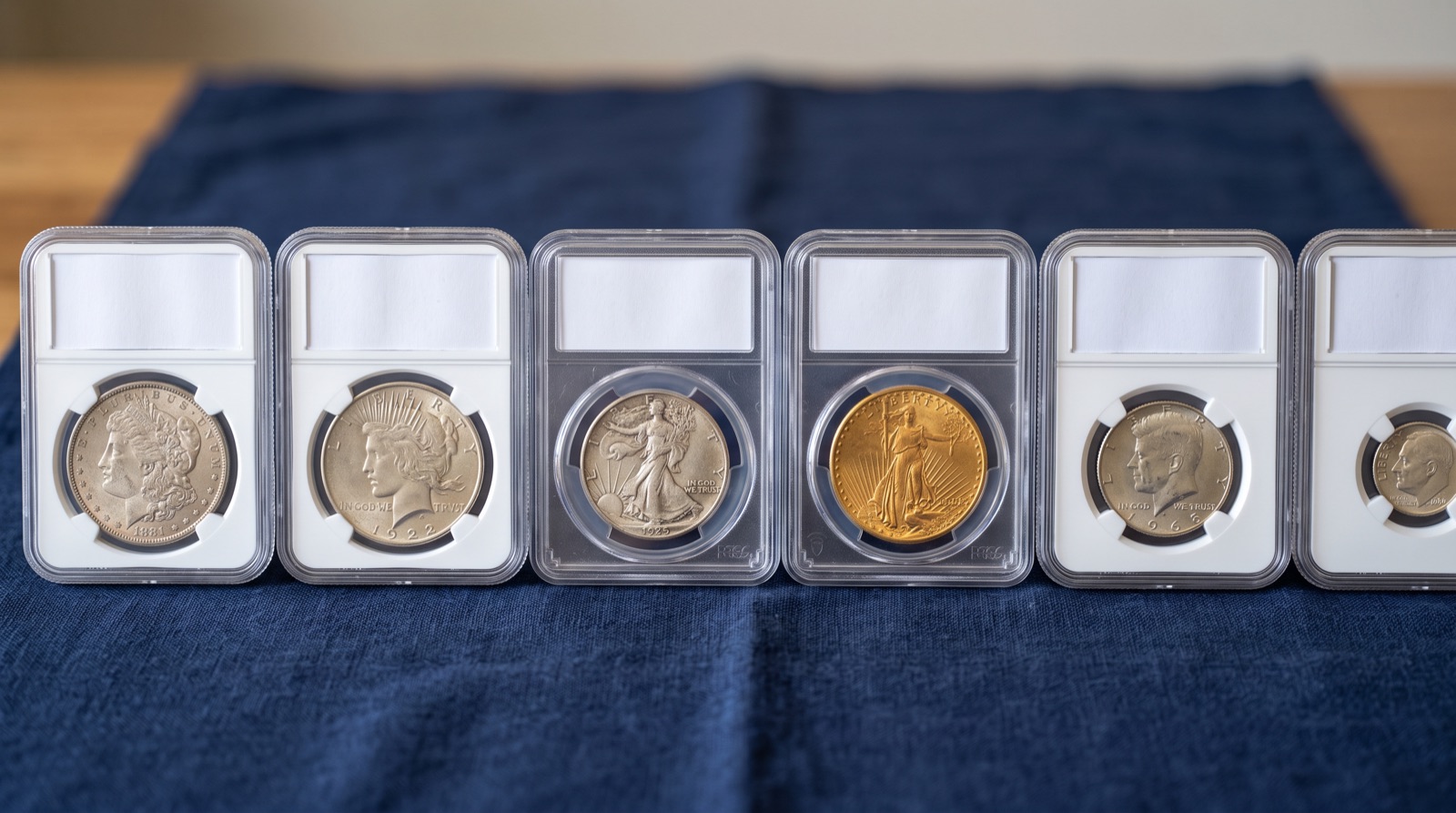
Coin grades look like alphabet soup — MS-63, AU-55, VF-30 — but the system behind them is simple once you see the whole ladder. Here’s a plain-English tour from the bottom of the scale to the top.
Where the numbers come from
Modern grading uses the Sheldon scale, a 1-to-70 system introduced in the late 1940s. Each grade pairs an abbreviation describing the coin’s condition with a number that places it more precisely. Higher is better, and the jumps in value between grades can be large, especially near the top.
The grading ladder, bottom to top
- P-1 (Poor): Barely identifiable. The type may be visible, but the date may not be.
- FR-2 (Fair) and AG-3 (About Good): Heavily worn, with parts of the lettering or date worn away.
- G-4 to G-6 (Good): Despite the name, a well-worn coin. The design is outlined but flat, and the rims are mostly intact.
- VG-8 to VG-10 (Very Good): Main features are clear, with some interior detail starting to show.
- F-12 to F-15 (Fine): Moderate, even wear. All major design elements are bold.
- VF-20 to VF-35 (Very Fine): Light to moderate wear on the high points. Finer details like hair lines and feathers are visible.
- XF-40 to XF-45 (Extremely Fine, also written EF): Light wear only on the highest points. Most detail is sharp.
- AU-50 to AU-58 (About Uncirculated): Just a trace of wear on the highest points. Much of the original mint luster remains.
- MS-60 to MS-70 (Mint State): No wear from circulation at all. The number reflects marks, luster, strike, and eye appeal.
What MS, AU, and VF really mean
MS means the coin never circulated. That doesn’t mean perfect — an MS-60 can be covered in bag marks from being jostled with other coins at the mint. An MS-65 has only minor marks and attractive luster, and MS-70 means no flaws visible under magnification.
AU is the most misunderstood grade. These coins look new at a glance, but tilt one under a light and you’ll see faint friction on the cheek, the eagle’s breast, or wherever the design stands tallest. An AU-58 is about as close to Mint State as a circulated coin can get.
VF is where many classic collector coins live. The coin clearly circulated, but it still shows real detail. For older or scarcer dates, a nice VF can be the most affordable way to own the coin.
Proof is a separate track
You’ll also see PR or PF, as in PR-69. Proof describes how a coin was made — struck with specially polished dies, often more than once — not its condition. Proofs are graded on the same 1-to-70 scale.
Who assigns the grade
Anyone can give an opinion, but for valuable coins the market leans on independent services like PCGS and NGC. They grade the coin, seal it in a tamper-evident holder, and record it in a searchable database. A coin that has been cleaned, damaged, or altered may come back with a “details” grade instead of a straight number, which flags the problem for the next buyer.
A few practical tips
Hold coins by the edges, never rub or clean them, and judge them under a single strong light. Grading is a skill that takes practice, and two experienced graders can disagree by a point.
Get a second set of eyes
If you’d like help reading the grade on your own coins, stop in at Washington Bullion, 311 E Main St, Union, MO 63084 — across from the courthouse. We’re open Monday through Friday 9am–4pm Central and Saturday by appointment, or call 1-636-744-8181.